andrejsala.lv
Start
 
Development Opportunities Culture Living JAU
CalendarEvent OverviewInterviewsMuseumsVideo
About Us  MapLV/EN/RU
Interviews
Andris Vītoliņš's Paintings: Homage to Industrial Past


Andrejsala's South End has already become used to the mural of an ambulance car, the portrayal of a soviet-era minibus that was made on the wall of the old Gatehouse about two years ago. You may also want to know that its author is Andris Vītoliņš, a successful modern painter and a local. Andris's approach involves using vivid acrylic hues to depict, for instance, transport vehicles made in the times of the USSR and various industrial scenes encountered in the city, such as abandoned factories and their apparatus. In September and early October of 2007, the artist exhibited solo at the Rīga gallery. A number of pieces displayed as a part of his Urban Positive. In Memoriam collection have been inspired by the phenomena specific to Rīga's Andrejsala: interior of the thermal power plant and meshworks of pipelines and girders. Intrigued by Andris's art, we talked to him about his creative method and the encounter with the industrial heritage in Andrejsala.


Some of the artworks seen at your solo show in the Rīga gallery depict soviet-made vehicles, such as a tram, several trains and an RAF Latvija minibus – these may have been forgotten or even never observed in real life by today's younger generation. And then there's an old type of bus... Does anything like this still exist, except in your paintings?


There is one that was uncovered and refurbished in Cēsis. The bus is operational and people are queuing up to hire it. I have a liking for history, which has made me read quite a lot about various artefacts of the past and even create an archive of sorts. While unearthing history, I also find out about social phenomena and sometimes discover that certain interesting things in Latvia have remained underappreciated. In any other town [than Rīga], it would be a matter of respect for culture to restore and bring back to service an old tramcar. I paint these things that were so characteristic of Rīga, for example, the RAF minibuses, which were also sold in seemingly unlikely markets, such as Cuba, Iraq and Afghanistan. Even if that part of the past has been obliterated, I'm interested in the stories of these things and, with my Urban Positive. In Memoriam exhibition, I retell some well-known, if perhaps, slightly dust-covered stories.


Paying homage to the past?

Yes, in this exhibition those are the RAF minibuses, painted on a soviet-made mattress fabric; they indeed have something "socialist" about them.


When the transformation from socialism to capitalism took place, the very rapid change in values also meant that the previous ones were renounced and abolished. Today, when an icon of soviet design resurfaces, it creates a certain level of nostalgia. What sentiments, in your case, are the basis for choosing the theme of soviet-built motor vehicles?

Well, here in Latvia, since recent times, we have this syndrome of orderliness, or Ordnung ('rules', 'order' in German), an obsession with neatness, a kind of totalitarianism that destroys all the old things. That's why I try to dig out the forgotten and exciting things. During the last year's White Night in Andrejsala, I was doing my mural of the ambulance minibus, and some of the officials in charge seemed to be getting worried why there's an RAF and why the Russian lettering. In Latvia there's a very pronounced inclination toward perfection and a rejection of double entendres. But this was a true story from 1975 about a minibus, which I fetched from its authentic environment and retold.


When telling these urban stories, you use your signature technique, the synthetic, pulsating neon colours. How did you start with that? 

I live in modernity and my creations also are addressed to it. If there's an old, forgotten story, I channel it through myself, through the prism of my interpretation of culture. If you're a musician who plays guitar, then you play songs on the guitar, even when it's a piano piece or a violin piece. My instrument of choice are the vivid neon colours, which I began to use as early as in the first half of the 1990s when studying at the Academy of Art. There, I encountered a squarely "soviet" doctrine: in the same way that the soviets had denied jazz because it was born in America, acrylic paint, another American product, was also disapproved of, vetoed and denied existence. The "colour policies" were absurd indeed: there existed a pre-defined Latvian palette, but I managed to obtain acrylic paint and used it to express my dissent. At our school, none of the professors worked in acrylic and even my study mates were rolling their eyes about my way of working. That was the situation that prompted me to make my new and different claim. 


The exhibition also includes your paintings of Andrejsala's industrial structures, the idiosyncratic workings observable at the thermal power station. How do you go about getting to know these types of environments, when in search for new impressions?

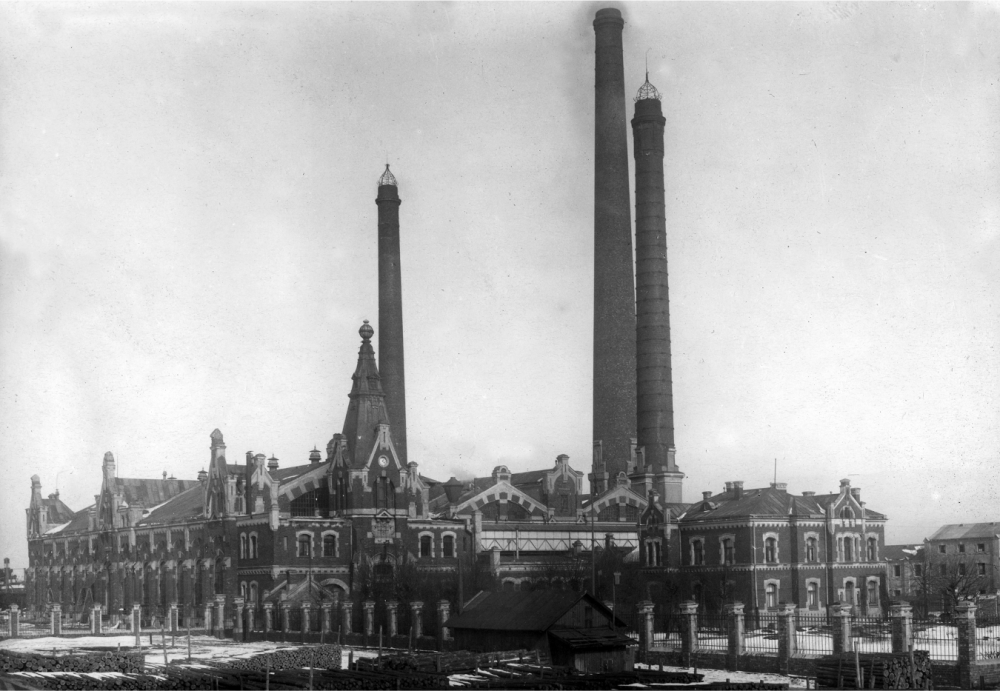
I did several photo shoots in Andrejsala, because the impending construction would destroy and transform many aspects of this environment. This resulted in a photo archive that contains stills of the more intriguing parts of Andrejsala's buildings and factories, and I might continue to use these photographs as a basis for my artwork. While here, I also talked to someone Valērijs who used to work for the power station, since the whole context of the place seemed interesting to me.


Do you follow any criteria when choosing this or that industrial site?

In fact, usually it starts with some preliminary idea, a general notion of the feelings and patterns that I'd like to put into the painting. Then I search around for that imagery. Alternatively, you may notice something new, become surprised about it and, sort of, start following the already existing object, even be led by it.


Does Andrejsala have its own uniquely identifying features, if compared to other industrial terrains?

Hard to say. Perhaps it's the fact that Andrejsala is right in the middle of the town, in central Rīga. And that it's been preserved. Tallinn used to have a similar area, but it was reduced to debris. The advantage of Andrejsala is that its buildings are still standing tall. In the early 1990s, many similar sites, such as VEF and Sarkanā zvaigzne, were gradually looted, vandalised and let to disintegrate. Andrejsala, in contrast, has conserved its authentic environment; therefore it requires a very careful probing as regards what should be disposed of and what ought to be saved.


There is, on the other bank of the Daugava, just opposite Andrejsala, one more curious area called Podrags. Have you been there?

Yes, and it's very interesting there. Podrags is a really overgrown place, a piece of jungle, I might say, and in the middle there's a stately stone building, someone's manor or lodge. I used to go to all these kinds of holes wherever there was access by car. The Daugavgrīva citadel used to be accessible. Nowadays many of those have been locked down.


Certain kinds of people – bohemians, anarchists and artists – seem to frequently carry out expeditions to various derelict sites, such as factories, industrial buildings and militarised zones. In Latvia, there exist maps made by enthusiasts that include these types of structures and list the potential dangers, access paths, and so on. Do you feel you too are one of the so-called industrial romanticists?

There are several Latvia-based websites published by these explorers, but I'm not really a part of that community. I was doing that quite a long time ago, when I was in school. Later, with my 4WD, we went to all the off-road areas and [former] military bases.  I had photographs of the earlier glory of Andrejsala when the footbridge still existed and the crane wasn't dismantled yet. Although Andrejsala didn't allow trespassing, the rule could be broken.


Is there a feedback link between you and the viewing public? How do you sense, or predict, their expectations concerning your artwork?

My works address my intellectual dilemmas. However, I sometimes deliberately embark on creating things that elicit certain associations in the viewer. For example, during the Andrejsala project, I was [initially] vacillating between several ideas, between several vehicles. I thought about creating a story out of [former Yugoslavian leader] Josip Broz Tito's Zastava car, which had appeared in Rīga. Finally I settled on the RAF Latvia minibus because it had been a lot more popular and was even a symbol of Latvia, which people can remember now.


You also have exhibited abroad, namely, in Austria, Germany and Slovenia. Is there a difference in how your art is appreciated in Latvia and elsewhere?

It's interesting to note that Latvians always look for aesthetics in the artwork and try to imagine how good, if at all, it would look hung on a wall in their homes. Foreign viewers first of all notice the social heritage; they also have a more liberal perception of twisted, incorrect things and show an interest in the unusual: "Okay, it's different, it's your way of thinking." In Rīga, an intellectually limiting factor is the attempts by everyone to define the one and only truth. One correct way. One best painter. One best artist.


What you said referred to the people of Western Europe. Have you had any chance to observe the trends in consuming arts and culture in Russia?

There's much more openness, people are more daring and willing to take risks. A Latvian, while regarding my artwork, would think: "So what's really in there?" It's the opposite for Russians because the more eccentric it is, the better they like it. They'd say: "Oh, yeah, nice!" In general, they're wackier and appear less concerned about petty details.


How independent can an artist be from the demands of consumers of arts and culture?

There are subgroups of artists who are paid through funding schemes as well as those who live for their customers. It might be, though, that the entire artist's trade is a mere bubble. An artist may suddenly become in vogue and a good many of his works would then be sold. Then again forgotten. But, time is the best judge of all things.


In an interview, when discussing competition among artists, you've said that you were the only industrial painter in Latvia and that there was no competition.

That's not really true. There are several Latvians who had and still have been working in this genre, and I would prefer to not position myself as the only one. The modern information space is very much imbued with symbols and advertising. It is an expression of favouritism: people like to attach labels, for example, the best, the most talented or one-of-a-kind.


And yet, you've become pretty popular within the Latvian fine art milieu: you're works have been included in the collection of the Latvian National Museum of Art as well as in private collections. Are you a hit?

I'm somewhat protective about what I do because otherwise one runs the risk of falling prey to the process. I draw the line quite carefully, by avoiding exhibiting just everywhere and instead choosing one or two galleries. Even if I could be a part of each and every exhibition out there, I choose not to. It is my safeguard against a possible energy depletion. I do not wish to become an off-the-shelf product.


However, if you're overexposed...

I think this exhibition marks the beginning of a new period for me; the next one will take place after two or three years. It's about time to pause, to think, to process.


There are also musicians who, due to self-respect, release albums only every three years or so.

Of course, because it gives you "space" to do your mental work. While you're young you can blast off one exhibition per year; but, if you learn to pause, you're in control of where you're going. Painting is just about being the master of your emotions and reason. All the time, you remain alert about what you do, whether what you do is the right thing, whether you're headed anywhere or just remain where you were before. At times you may realise that you're coming to a freeze.


So, is this how you, without following any established recipes, find a way to realising yourself?

Yes, and there might be dangerous turns: when public has seen your artwork, it creates a kind of pressure of expectations to see again the same things that were there before. Then it may become harder to transcend yourself.


In your recent exhibition we saw that some of your imagery has changed; for example,  against the background of the industrial meshwork, there have appeared some atypical flying objects, and this, from a conventional point of view, may seem to interfere with the "regular" composition. Why is there such an invasion of seemingly harmless objects?

First of all, my objective was to encourage people to think differently. It's also a way of playing with my own ideas, an attempt to overcome something in myself. While releasing oneself of the simple phenomena, venture into something more complicated. If there are ideas that return to me persistently, I just accept them and create. I'm also interested in the idea of space and ghosts inhabiting it: that's how the stories belonging to a particular location come alive. I may start by painting realistically but, when symbols are added in the picture, the normal composition falls apart due to emergence of new stories, in which the physical objects become a part of a literature. I like motion and objects in motion, which seem to charge toward the viewer. It may be the direction that I will follow also in the future. Why are there firearms in the painting? Humans have been removed but the inanimate objects alone tell the story. There's as if nobody there, but the painting preserves a sense of animation. When you see a person in the street, you are mostly able to tell what they are: are they a white-collar, a local, a foreigner, etc., and you can deduce it even if the person didn't move, just by noticing the various objects in the situation. Those are symbols. And that's how objects and the material world narrate a story.


Recommended: the website of artist Andris Vītoliņš, www.vitolins.lv.


« Return   |   Top   |   Print